how many species of finch live on the galapagos
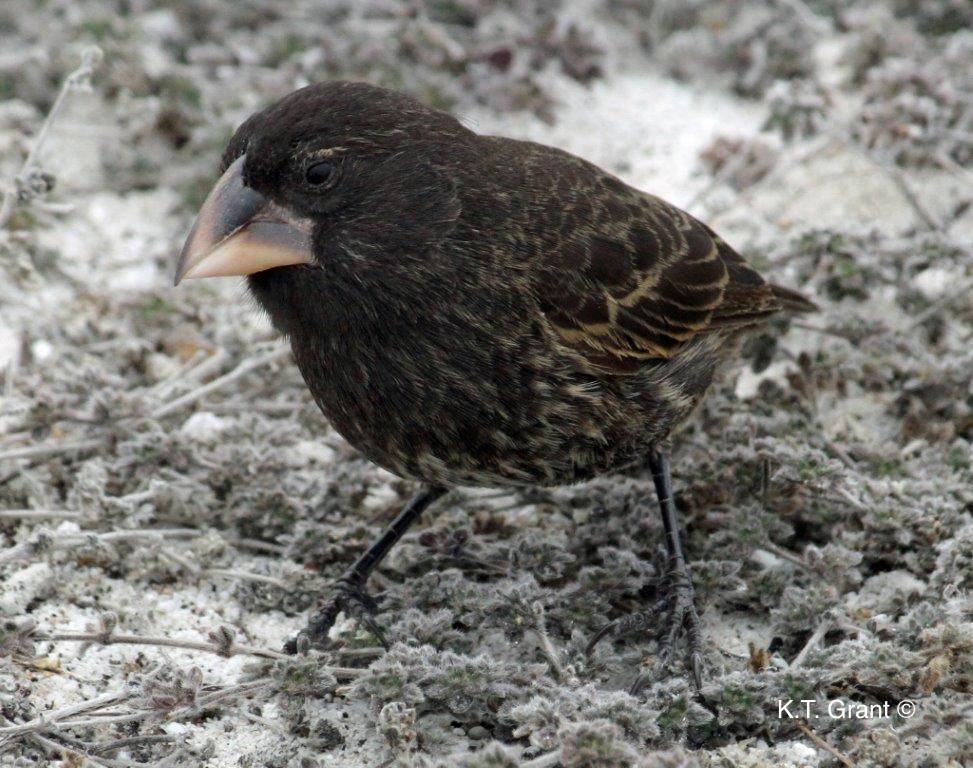
A virgin study illustrates how new species can arise in As little as cardinal generations. The study tracked Darwin's finches on the Galápagos island of Daphne Major, where a member of the G. conirostris species (pictured) arrived from a distant island and mated with a occupier finch of the species G. fortis. The offspring highly-developed into a new species that the researchers call the Big Bird blood line.
The arrival 36 years ago of a singular bird to a distant island in the Galápagos archipelago has provided direct genetic evidence of a novel way in which new species turn out.
Along Nov. 23 in the journal Science, researchers from Princeton University and Uppsala University in Sweden report that the newcomer belonging to one species mated with a member of some other species resident on the island, freehanded rise to a hot species that now consists of roughly 30 individuals.
The study comes from work conducted on Darwin's finches, which live on the Galápagos Islands in the Pacific Ocean. The inaccessible location has enabled researchers to study the evolution of biodiversity due to natural selection subordinate pristine conditions.
The direct reflection of the origin of this newfound species occurred during field work carried unstylish over the last four decades by B. Rosemary Ulysses Grant and Peter Grant, a wife-and-husband team of scientists from Princeton University, on the littler island of Daphne Major.
"The novelty of this study is that we can follow the emergence of new species in the wild," said B. Rosemary Grant, a senior research life scientist, emeritus, and a senior biologist in the Section of Ecology and Evolutionary Biology. "Through our work Daphne Major, we were able to observe the sexual unio up of deuce birds from various species and then come after what happened to see how speciation occurred."
In 1981, a graduate student working with the Grants on Daphne Major noticed the freshman, a male that Panax quinquefolius an unusual birdcall and was much larger in organic structure and beak size than the three resident species of birds on the island.
"We didn't see him fly in from over the sea, but we noticed him shortly after he arrived. He was so antithetical from the else birds that we knew he did not hatch from an egg along Daphne John Major," said Peter Grant, the Form of 1877 Prof of Zoology, Emeritus, and a prof of ecology and organic process biology, emeritus.
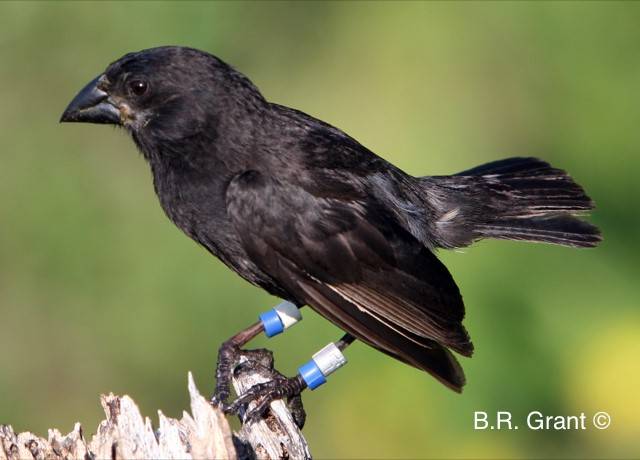
The bird is a penis of the G. fortis species, united of two species that interbred to give rise to the Massive Bird lineage.
The researchers took a line of descent sample and free the razz, which afterward bred with a resident medium ground finch of the species Geospiz fortis, initiating a new lineage. The Grants and their research team followed the new "Big Bird bloodline" for six generations, winning blood samples for utilise in genetic analysis.
In the current study, researchers from Uppsala University analyzed DNA collected from the parent birds and their offspring o'er the eld. The investigators discovered that the original male raise was a large cactus finch of the species Geospiza conirostris from Española island, which is more than 100 kilometers (about 62 miles) to the southeast in the archipelago.
The remarkable distance meant that the male finch was not able to getting even home to first mate with a penis of his own species and so chose a mate from among the three species already on Daphne Star. This reproductive closing off is considered a critical step in the development of a newfangled species when two separate species interbreed.
The young were also reproductively stray because their song, which is old to attract mates, was unusual and failed to attract females from the nonmigratory species. The offspring besides differed from the resident species in beak size and shape, which is a major cue for partner choice. A a result, the offspring mated with members of their own lineage, strengthening the development of the new species.
Researchers previously assumed that the formation of a new species takes a very long time, but in the Big Bird lineage information technology happened in just ii generations, according to observations made by the Grants in the line of business in combination with the genetic studies.
Study of Darwin's finches reveals that spick-and-span species tail build up in as little As deuce generations
The direct observation of the origin of a new species occurred during sphere work carried out over the last four decades by B. Rosmarinus officinalis Grant and Peter Grant, a wife-and-conserve team of scientists from Princeton, on the small island of Daphne Stellar in the Galápagos Islands in the Pacific Ocean.
All 18 species of Darwin's finches derived from a undivided ancestral species that colonized the Galápagos about one to two million years agone. The finches have since heterogenous into different species, and changes in beak shape and size make allowed different species to utilize dissimilar food for thought sources along the Galápagos. A critical requirement for speciation to occur finished cross of two distinct species is that the new parentage must be ecologically competitive — that is, good at competing for food and other resources with the other species — and this has been the cause for the Big Bird lineage.
"It is very hit that when we compare the size and shape of the Big Bird beaks with the schnozzle morphologies of the other three species inhabiting Daphne Major, the Big Birds occupy their own recession in the beak morphology space," said Sangeet Lamichhaney, a postdoctoral fellow at Harvard and the first writer on the study. "Olibanum, the compounding of gene variants contributed from the deuce interbreeding species in combination with selection led to the evolution of a beak syllable structure that was free-enterprise and unique."
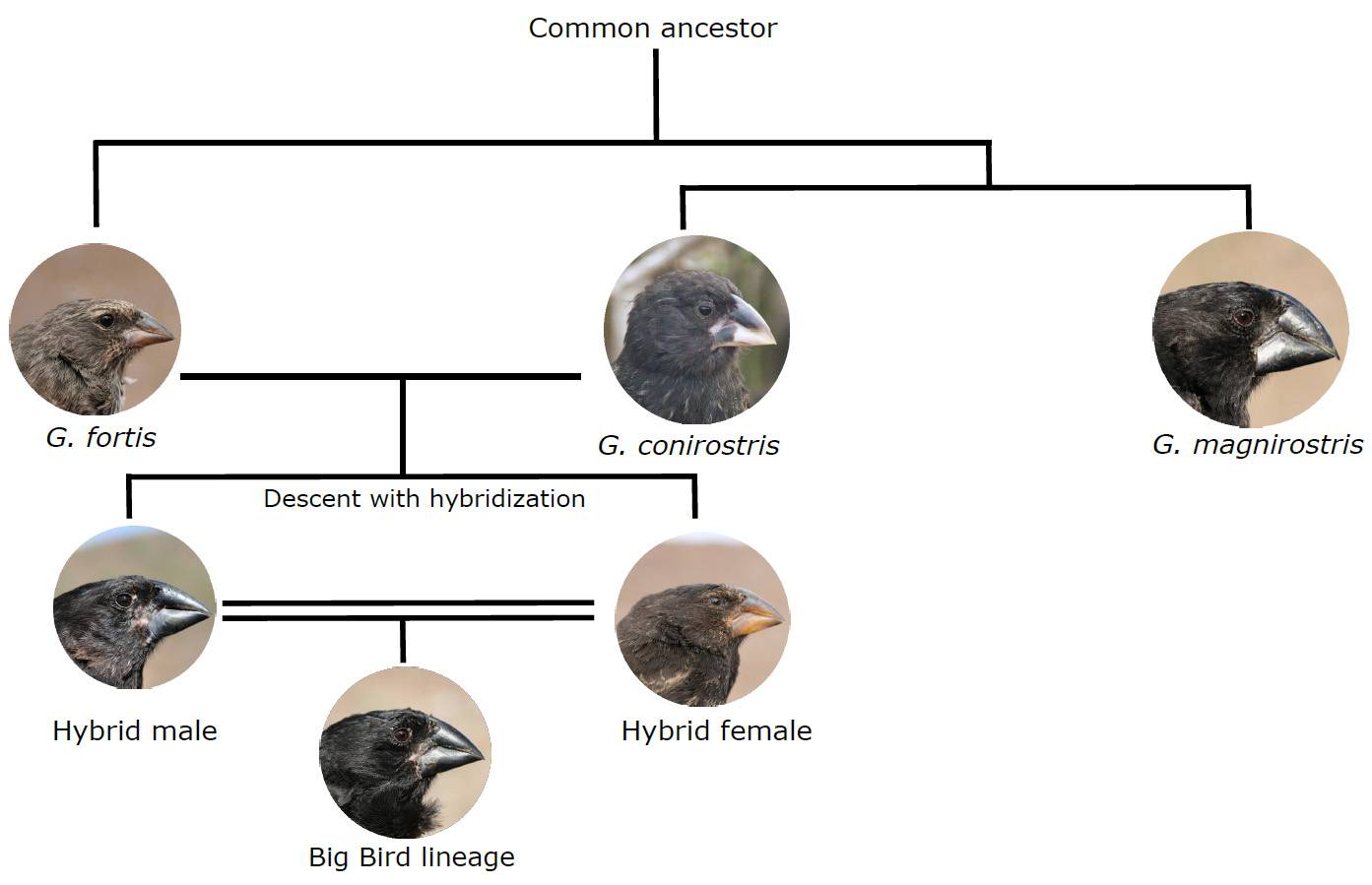
Nonrepresentational illustration of the evolution of the Big Bird lineage happening the Daphne Major island in the Galápagos archipelago. At the start an immigrant large cactus finch male (Geospiza conirostris) bred with a medium ground finch egg-producing (Geospiza fortis). Their offspring bred with each other and strange the Big Bird lineage. Photos © K. Thalia Grant for G. conirostris and Saint Peter R. Hiram Ulysses Grant for the remainder. Reproduced with permission from K.T. Allow, and Princeton University Press, which first published the remaining images in "40 Age of Evolution"
The definition of a species has traditionally included the inability to produce fully fertile progeny from interbreeding species, as is the case for the horse and the Equus asinus, for example. However, in recent eld it has become clear that some closely related species, which normally ward of breeding with each other, do indeed bring about offspring that can pass genes to subsequent generations. The authors of the take have previously reported that in that respect has been a considerable amount of gene run over among species of Darwin's finches over the last several thousands of age.
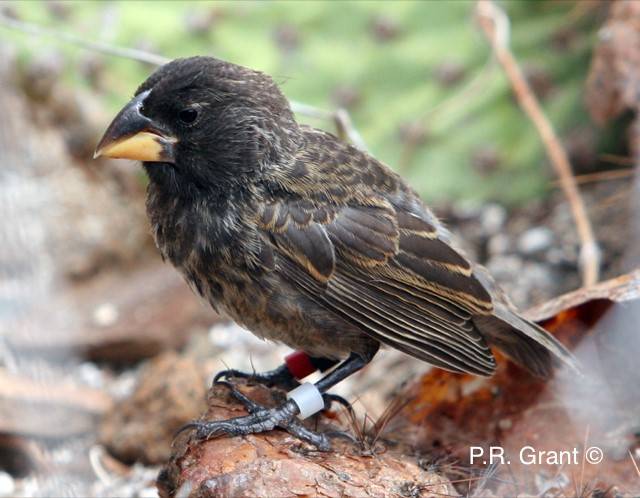
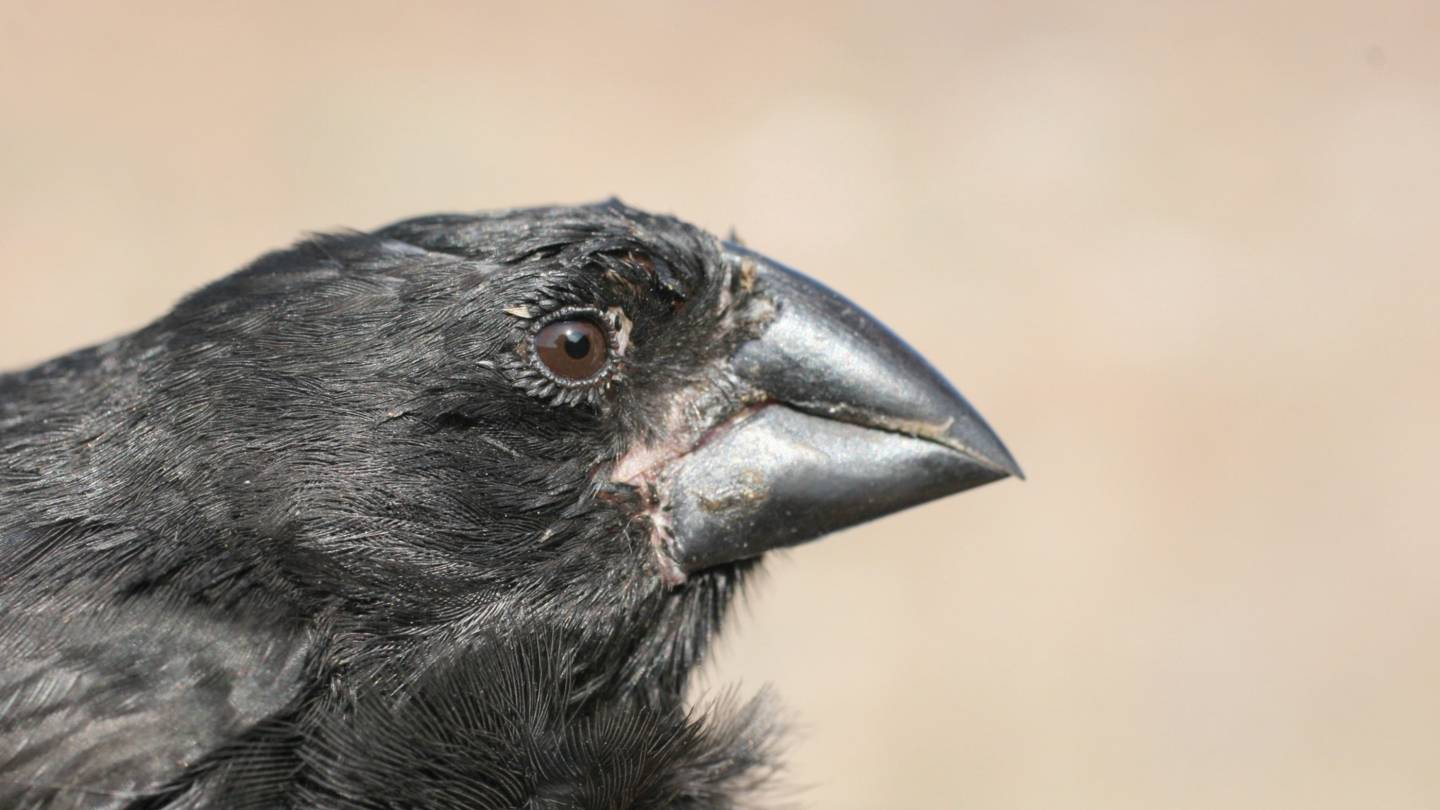
The breeding of deuce distinct parent species gave rise to a new origin (termed "Big Bird" by the researchers). This lineage has been obstinate to be a radical species. This simulacrum is of a member of the Big Bird lineage.
One of the most striking aspects of this study is that cross between 2 distinct species led to the evolution of a new linage that after only two generations behaved as any other species of Darwin's finches, explained Leif Andersson, a prof at Uppsala University who is also affiliated with the Swedish University of Agricultural Sciences and Texas A&A;M University. "A naturalist who came to Daphne Major without wise to that this lineage arose really recently would have accepted this lineage as one of the four species along the island. This clearly demonstrates the value of long-staple-running playing field studies," he said.
IT is likely that new lineages alike the Big Birds have originated many times during the evolution of Darwin's finches, according to the authors. The majority of these lineages have bypast nonexistent just some May have light-emitting diode to the organic evolution of contemporary species. "We have no indication about the long survival of the Big Bird lineage, just it has the potential to become a success, and it provides a beautiful example of one way in which speciation occurs," aforesaid Andersson. "Charles Darwin would have been excited to learn this paper."
The subject was supported by the Galápagos Internal Parks Service of process, the Charles Charles Robert Darwin Creation, the Nationalist Science Foundation, the Knut and Alice Wallenberg Creation, and the Swedish Research Council.
The field, "Rapid cross speciation in Darwin's finches," aside Sangeet Lamichhaney, Rooter Han, Matthew T. Webster, Leif Andersson, B. Rosemary Grant and Peter R. Grant, was publicised in the journal Science on Nov. 23.
Upsala University contributed to the complacent of this press release.
how many species of finch live on the galapagos
Source: https://www.princeton.edu/news/2017/11/27/study-darwins-finches-reveals-new-species-can-develop-little-two-generations

Posting Komentar untuk "how many species of finch live on the galapagos"